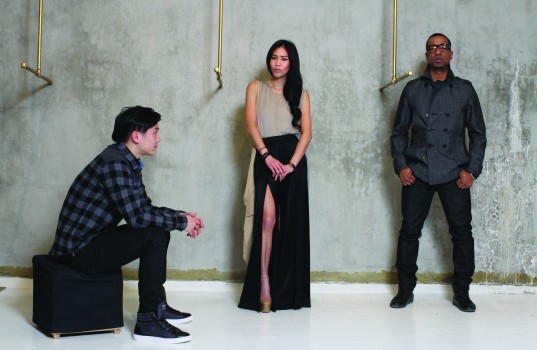
ONE ON ONE: This is Fashion Business
Toronto’s fashion and design industries are shaking up the way we dress, play and live. Spearheading this movement are George Sully and Amanda Lew Kee, two major players who know all there is to know about business, branding and balance.
By David King
Looking good requires much more than just throwing on a new pair of kicks and fitted jacket. It’s about oozing personal confidence and making creative choices, something George Sully does in spades. The designer, philanthropist and one-half of shoe and handbag line Sully Wong has built for himself a solid niche in the boutique fashion industry, earning the moniker ‘Purveyor of Lifestyle’. Now, with years of experience under his stylish belt, Sully is focused on giving back to the community and working with emerging designers like Amanda Lew Kee, who has been tasked with designing a new women’s shoe line for Sully Wong. Joined by partner Henry Wong, the fashion experts sit down with The Bull to discuss what it takes to make it in today’s competitive marketplace and how they see style and business evolving.

BUILDING BRANDS AND BUSINESSES IN CANADA
You’ve all been part of building brands and businesses. Tell us what it means to be doing this in Canada and how you feel your mark is being made at home and around the world.
Amanda: For Canada it’s a great time to be building brands. We’re still such a young country so there is yet to be a right or wrong way to create a Canadian brand. We as a whole are made up of many different cultures so when we successfully build something, it’s a hybrid of what works. We as brands are building our culture of what it means to be Canadian.
George: These days there’s no ceiling for us as Canadian designers; the old guard and way of doing things are over. It’s the Wild West and because of our age group, it’s all we know. We easily navigate with various disciplines with no one entity telling us or dictating to us what to do, or we’re not listening because it’s no longer relevant. It’s a bit of a free for all, giving all fashion entrepreneurs an equal opportunity.
Henry: Agreed. Toronto is a very young city. We have so many people from our city doing well and representing our city worldwide. People are starting to really pay attention to the city so I think building a brand within the next couple of years will develop a solid foundation of the new guard for years to come.
Amanda: It’s very true, especially in Toronto where we have a lot to offer and there are now many eyes on us. You can see it everywhere with international hotels like The Ritz, The Trump and the Shangri-La, which all opened in the same year. And, of course, you can’t forget about the Toronto Soho House coming to town and the recent announcement of the arrivals of Saks Fifth Avenue and Nordstrom. People are looking at the city to invest, and it brings Canada to the international stage. It’s all happening here and now.
How has the industry and business playing field changed in recent years and how have you been able to capitalize on opportunities as a result?
George: Social media has levelled the playing field 100%. Connecting with the world, whether it be as collaborators, suppliers or just reaching out to fans of our work, is made much easier now with social media. Personalities want to reach out directly. Though the chain of command vis-à-vis management has always been something to respect, getting access to personalities organically has made all the difference. Much like how free distribution of music on the internet has changed the industry, social media is the new variable that management, PR and talent handlers now have to navigate and adapt to.
Amanda: And also with the industry going online, it gives businesses like ours more of an opportunity to compete logistically. It’s no longer about new information being released quarterly in print or seasonally on the sales floor. Thanks to online publications and e-commerce, things are now by the minute, up to date.
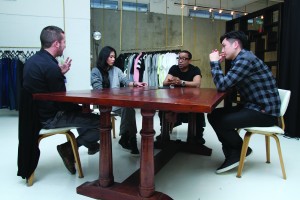
COLLABORATION VS. COMPETITION
Can you tell us how you see collaboration as a strategy for your business and what benefits and challenges you draw on from these efforts?
George: We’ve always welcomed collaborations as a brand. We’ve worked with corporate entities as well as young brands alike. There’s no harm in coming together when there’s equal respect and understanding of the end goal.
Amanda: Collaboration is when you get a true sense of business as an art, when you surround yourself with people who you trust for their experience both professionally and creatively. If you work for a large company where everything is under only one director, there’s no trust being formulated downwards. When creating, you are forever collaborating, curating and trusting your team, which brings life to the company as a whole. A designer dress is an object that comes to life through the collaboration between a stylist, photographers, beauty artists and models, thus creating a dress packaged as a product. I hope that makes sense.
George: That makes perfect sense. Kanye experienced that with Nike. Not all collaborations end amicably. It’s not for me to choose sides as I was not privy to the contract stipulations but needless to say, the bigger the collaboration doesn’t necessarily mean the better the outcome. For any collaborative effort to work there has to be equal balance and respect.
Considering your competition in the industry, how do you view competition as a driver of what you do? Are you constantly looking to evolve your game in order to keep up or is sticking to your own lane that much more critical to your overall success and happiness?
Amanda: I’m my worst competitor. That’s all I have to say to that. It’s not always a good thing.
George: Absolutely true Amanda. These days, we are indeed fighting against ourselves. Everything has changed. One might have a million followers versus a competing brand that only has 300, but those 300 followers are constantly engaged in the conversation, liking, following, clicking, and best of all purchasing. The optics say your million is hot, when in actuality they’re a far second to your competitor’s 300. The fight truly lies in how good you are as an individual at engaging your followers, and no one can do it for you.
You’d be surprised by how many brands out there are unknown commercially but yield millions in revenue annually amidst there own social network. So these days, I’m not looking over my shoulder for competition. Henry and I spend most of our time digging for super talented entrepreneurs we can join forces with to create great things, much like with Amanda.
Amanda: But just to add to that, with companies that may be direct competitors or even complimentary brands, I find it’s good to keep a list of who they are so that you know how to gauge where you’re going and in which direction. It’s beneficial to learn from all of them. Relating back to collaborations, veteran companies may not know how to brand our lifestyle [referring to the current generation] and that’s where they see we have something stronger in a more boutique way. It’s something they can’t represent because they are either passé or diluted. In that sense, the competition goes both ways.
When you consider trends towards capsule collections and limited edition releases, how does partnering up enhance your efforts, and what do you look to bring to the table when pursuing these initiatives?
Amanda: Capsule collections allow the smaller brands to get their names out there and to continuously develop and grow without the investment of mass production. With collaboration, it’s about movement and the bigger players actively trying to keep up with the small boutique brands that have more of a direct vision as opposed to a broad look at things. For them to invest in a capsule collection, it brings value to their image of relevancy while helping their movement to push forward. It’s like hitting a refresh button.
George: The truth is collaborations and good collaborations have been around forever, and I think if you’re doing it for the right reasons and maybe even giving back in the process, it’s always going to help. The key is the right collaboration in the right frame of mind.
How important is it for you to pay it forward and give back to those coming into the fashion community?
George: Giving back is very important to us. We’ve been blessed to work with various non-profit entities in the past. Of note, we’ve just finished work on a collaboration for a low-cut sneaker with ONEXONE, a non profit organization led by Diesel Clothing Founder Joey Adler.
Amanda: I think mentorships are really important, especially when starting up. I’ve had many and they’re all still very close friends of mine and we learn from each other. It becomes a very personal thing, to want your people to experience success. Looking back at my climb, my own struggles and the opportunities that I had so early in the game and the contacts that were opened up to me, it only feels right to continue that mindset of helping others. It’s great to connect networks and watch the magic happen because I know it has been done for me.
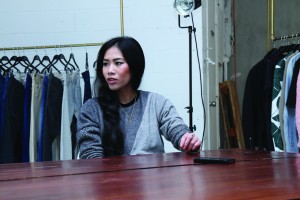
PERSONAL VS. PROFESSIONAL STYLE
Looking around the table, it’s clear that our personalities are reflected in our personal style. Being in the business of dictating style, can you tell our readers what you hope to articulate through your designs?
Amanda: I see myself more as an artist so my personal style is whatever I feel at that moment. I don’t like to live inside a box of conformity so if I want to show up somewhere –
George: – naked.
Amanda: (Laughs) I’ve come pretty close. I find it entertaining to wear the most amount of fabric in the room, sleeves down to the wrist, hemlines down to the ankle with high necklines, but it really comes down to playing with sheer fabrics. I also wear a lot of blacks, black with an ‘S’ as there are many shades of black. I get really excited over the perfect amount of textures in playing with black, whether it be a balance or asymmetry.
But in terms of design, I’ve honestly had some pretty deep collections. During my earlier seasons, it was more about exploring my own sense of style and direction. I designed a collection that was inspired by natural disasters and juxtaposed it with natural resources (Natural Disasters/Natural Resources). It was my expression of the relation between our disasters and harvested resources. That one was interesting because when I showed that in Toronto, people misinterpreted my iridescent oil slick textile for Christmas wrapping paper. It wasn’t until the very same appeared on bigger runways in New York and London that it was accepted.
George: Freedom! Do what you feel! We are very aware of the industry’s highs and lows. If you’re able find the medium between the two extremes you can overcome anything. This is us. It just so happens that our personalities and style happen to fit nicely into a business model.
Amanda: And just to close out this point, I’ll also say that people think the fashion business is a lot more glamorous than it is. Trust me, it’s not.
What can you tell me about Bay Street style and how it’s evolved?
Amanda: From what I see, people on Bay Street don’t seem as much like drones as they used to. You see this especially in the fashion and style of dress. People today want to stand out and be seen as risk takers in business. To be honest, I don’t know a lot about Bay Street but I know it’s home to relatively conservative people. The ones who have their own style are probably the ones who are pushing to go to the top; they use peacocking as a strategy to stand out and show that they have an opinion. With the luxury market growing, consumers are starting to realize that fashion as a wardrobe is more of an investment. Bay Street can afford to do it and this is where the middle market always seems to get pushed into more standard, uniform clothes.
George: Absolutely. Lifestyle is lifestyle and from my perspective it’s going to bleed in and happen organically. Today, there’s a younger generation on Bay Street and their attention to style isn’t at all like their parents’. Like the clothing we make, it’s a hybrid thing where lifestyle meets fashion meets luxury.
Amanda: It has a lot to do with lifestyle. We as ‘creatives’ live and breathe what we do but even bankers have personal taste outside of work. And come the weekend, you see some Bay Streeters in their tailored suits speeding away on their fixie bikes and scooters. That’s awesome. That’s how it should be.
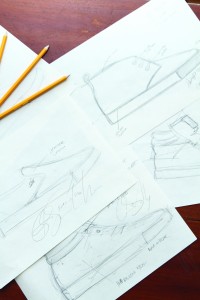
THE FUTURE OF FASHION AND BUSINESS AS YOU SEE IT
As the nature of the game continues to change, how do you envision the roles you play in your businesses changing and what hats/skills do you see yourselves taking on in the future?
Amanda: Right now I wear all the hats and I honestly think it’s the best way to grow a business since you learn each job inside out. With growth, I will need to delegate more and you can’t tell someone else what to do without knowing how to do it by yourself.
George: You’re on the money, Amanda. For me, it’s all about wearing different hats, especially in the beginning. Knowing as much as possible about your process will only ensure a more concise vision in the end and create something you can then teach to others. I feel a return to boutique style service coming back and big companies are trying to learn that now. Luckily for us, it’s an everyday thing, learning-curve free!
Amanda: Before, when you’d have your investment budget to expand, the old school way of thought would be to use that towards bringing in more people to break down a project into many little jobs. But this strategy isn’t always the most productive since a larger team takes more time to communicate. Today in fashion, there are a large number of houses with small teams, where expansion is focused on the production level instead of diluting the creation and direction. For capsule companies like ours, when we expand it shouldn’t be that we send our jobs off to smaller people but rather pass knowledge and tasks off to people who we can trust and cultivate.
BALANCE AND FINDING THE WIN
Outside of your world as a professional, what do you do in your personal life to strike balance and maintain your personal sanity?
Amanda: I spend a lot of time with my family but I come from a business background so our conversations tend to go off in that direction. I enjoy it though, it’s challenging and keeps me on my toes.
George: I will tell you right now that I still pinch myself daily. I’ve got a grade 12 education but I pinch myself because I get to travel around the world and meet these great people that we’re able to connect with on something major. There’s nothing to complain about. Sure, I’m trying to find balance and I may have lost a relationship or two along the way because I may have been too focused on my work at the time, but I’m learning. I love what I do and put out there. I’m lucky. We’re grinding but it’s our grind and it’s awesome.
What does ‘winning’ mean to you?
Henry: Speaking for myself, winning is keeping me happy with a big, fat smile on my face. I love what I do. I used to be on Bay Street and work the 9-to-5 but you would see me after work at the bar and I’d be complaining about everything. Right now, we’re happy and when you ask how I balance myself, my answer is I don’t need to because I’m working and playing at the same time. We get paid to do what we love and there are no complaints. I’m happy.
Amanda: Winning for me is having a job that doesn’t feel like a job. When turning a natural interest and talent into your life, there are much more personally rewarding successes. I’ve experienced this at such a young age and wouldn’t change a thing. Some people just aren’t open to seeing opportunities that may be out there for them.
George: Winning is being able to do what you want to do. No obstructions, no ceilings. That’s what I do, that’s what we do around this table and we’re winning right now. It’s about collaboration without the stresses of the old guard and who’s going to approve this. We don’t have to justify our vision, and this is winning on our own terms.
Related Posts



« COLLABORATION AT WORK: Dinner and Drinks at Blowfish Beauty Remedies: Banish Dry Hair »

