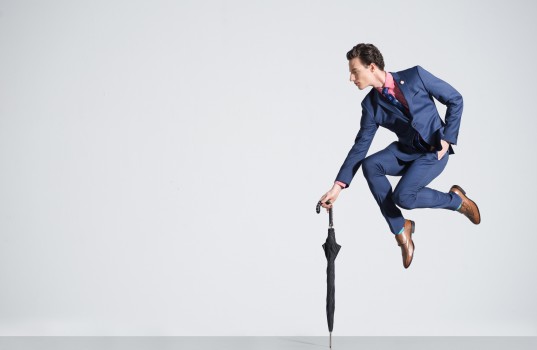
How to Wear A Spring Suit, featuring the National Ballet of Canada’s Brent Parolin
With winter coming to a thaw, it’s time you shed your inhibitions and embrace a wardrobe with some personality. We teamed up with Brent Parolin of the National Ballet of Canada to show you how.
Suit by Lab, $995; shirt by Moods of Norway, $160; tie by Duchamp, $150; lapel flower by Doro, $20; socks by Happy Socks, $15; shoes by GOTSTYLE, $225; umbrella by Pasotti, $250.
Give us a little background. How did you get into ballet?
Well, I’m from Prince George, British Columbia and started dancing when I was six. When I was younger, I would always be dancing around in my living room and one day, my mom just asked if I wanted to go to a class. When I was thirteen, I auditioned for the National Ballet School of Canada and did the summer school in Toronto, which I loved. I stayed for four years until I moved to Stuttgart, Germany after graduating for my first job. I was offered an apprenticeship there, which led to core and eventually, a promotion to half soloist after about three years of working for the company.
What were some the experiences that you learned from your time at the Stuttgart Ballet?
As a dancer, you really have to open up because they have such a diverse repertoire. My idea of ballet from when I was younger was, not closed, but in a very Canadian sense of what we were seeing at the company. There is a big box office mentality to fund the ballet. But at Stuttgart, they had a very diverse repertoire and the opportunity to present avant-garde works. My view of what dance is and what a ballet performer can do really opened up.
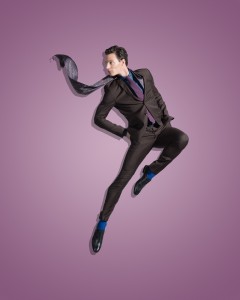
Suit by Tiger of Sweden, $830; shirt by Tiger of Sweden, $250; scarf by Ted Baker, $100; tie by Strellson, $100; shoes by Hudson, $185.
You’ve had the chance to see the world. What do you take away when you are traveling?
I’ve been to Seoul, Tokyo, Osaka, Shanghai, Beijing, London, Madrid, Copenhagen and more, to name a few. I find food is a huge doorway to culture in different countries. Whenever I go to other places, I try to eat authentic cultural foods and get a literal taste of what it’s like to be in that area. I also like to see the sights, but sometimes that can be difficult because you arrive and only have that day to go out and see things before you head straight into rehearsals. It’s not a vacation; you’re there for work.
Professionally speaking, there were a few times when I was in London and Spain where I was able to see other companies perform. Seeing that broadens your view and makes you analyze what you see and prioritize in your own aesthetic. It doesn’t change your point of view, but it educates your point of view more.
Do you think different cultures perceive ballet in different ways?
Definitely. I think they perceive dance and ballet in different ways, and I think the way they perceive ballet is the way they perceive art in general. In Russia, they have a very high regard for the ballet dancer, but also a huge regard for art and heritage. A lot of their ballets come from a historical point of view. Canada is a lot younger, so there isn’t the same groundwork and foundation laid down for that kind of context. From a financial point of view, art is not always the most grounded investment. It’s not a product that you can put your money into and get out of in the same way as you can do with a sports team or something similar. It’s more qualitative than quantitative. If it’s a financial-based society, it’s going to be harder to convince people to spend their money.
Is there a lot of competition between dance companies?
No, the dance world is quite small. There’s a lot of camaraderie, especially among the top-tier companies. Everyone knows everyone. With the galas, it’s a lot of the same people you see over and over again. There is a relationship you build with these people that you work with constantly, and a certain network because the industry is so small.
You made mention of a box office mentality of sorts. How do you think companies should balance their commercial and creative-based performances?
You can have a creative work that is still very box office-friendly. The past program of Chroma is a good example because it was a hit, but was still modern and contemporary. It’s not your average narrative story ballet. Then you have something like Alice [‘s Adventures in Wonderland], a big family-friendly production where it is very much a spectacle that brings in the biggest amount of people and tells a narrative. People are familiar with the story and have an idea of what they’re going to see. I think that they go well with each other, and when you do the bigger box office things, you can support bringing in new ideas and educate audiences that way.
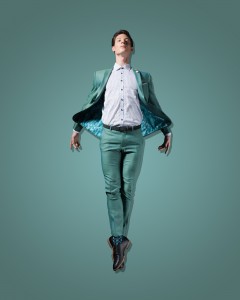
Suit by Moods of Norway, $450; shirt by SAND, $225; shoes by Hudson, $175; belt by Strellson, $110; pocket square by DION, $25 for set of three; lapel flower by Doro, $20; socks by Happy Socks, $15.
What do you think about how Hollywood and pop culture portray ballet?
I think Hollywood, music videos and things like that always take the clichéd version of things. I always think that the clichés are there for a reason; they don’t just come out of nowhere. They come from a section of the dance world, but as a general representation, I think it’s a caricature of what they show. There are problems, there are benefits. It’s just like any other industry.
How do you think the ballet is embracing technology and this digital age we’re going into?
With the National Ballet of Canada, they’re pushing more videos online and through social media, showing what’s going on and how everything is being put together. Companies who want to push it into the digital age are doing so, but there is a bit of a slower turnaround because it is an old art form. And there are a lot of rights and contracts involved. You have to also keep in mind that it is live theatre, so you don’t want to put something out digitally and lose the intimacy between the audience and the live performance. I think little snippets and vignettes of what you can see live would be the way to go rather than giving it all away.
It’s interesting to see how businesses adapt and evolve, especially with social media and the transparency to which companies portray themselves. How do you think the ballet attracts new audience members who aren’t as familiar with the art?
I find that the National Ballet of Canada has a very strong social media presence. They’re on Facebook, Twitter and Instagram, and they use those platforms to show people who are interested what is going on behind the scenes, what happens at costume fittings, what happens in studio and more. It’s an in-depth look into the bigger picture of what goes into making a ballet.
Do you think traditional audiences embrace that or is it a way of bringing in a new demographic?
I think it’s both. If you look at some of the followers on Facebook and Instagram, you do see some people who are very young and others who are mature and intrigued. They all enjoy seeing all that extra information.
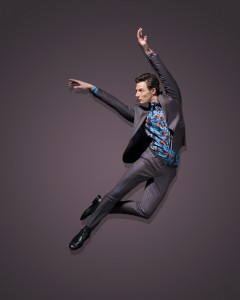
Suit by SAND, $995; shirt by Circle of Gentlemen, $300; shoes by John Varvatos, $350; belt by Strellson, $110; socks by Happy Socks, $15.
How do you think ballet has evolved over the years?
I think the ability level has grown exponentially. What people expected to see or were expected to do at the ballet fifteen or twenty years ago has changed – the legs are higher, the lines are more clear. The way the technique is presented has become harder for dancers. As an audience member, there’s more range of what’s acceptable to present as an idea. Before it was a lot of fairy tales and mythical creatures – very storybook. Now, it can be a bit more relatable and speak to real situations.
What does a typical day look like when you’re preparing for a performance?
If it’s a normal rehearsal day, I wake up at seven and have a cup of coffee with breakfast. I hit the gym and then warm up for class, which goes on for an hour. Rehearsals go from eleven-thirty in the morning to six-thirty in the evening, and then dinner and a good night’s rest.

Suit by Tiger of Sweden, $950; shirt by Oscar of Sweden, $200; tie by Seward & Stearn, $180; shoes byGOTSTYLE, $225; belt by Strellson, $110; pocket square by DION, $25 for set of three.
All clothes available at GOTSTYLE
Can you describe some of the physical demands that you have to put yourself through in order to get ready for a show?
We train every day and that’s a must. For me personally, I also go to the gym six times a week because there is a certain amount of stamina that you have to have. If you’re out of breath in the first five minutes, then you’re never going to make it in a three-act ballet. If you’re partnering, you have to have strength and coordination. A lot of these things come from years and years of training; professional dancers start when they are four, five, six years old. So it’s developing the coordination and aesthetic from a young age that you build upon. You constantly have to be in a certain physical performance mentality. Depending on the program, you also have to fine-tune your body towards that as well, which can be determined by everything from the costume to how much partnering there is.
If there was anything that you could educate people on about ballet, what would it be?
I think sometimes people forget that ballet dancers are athletes. It’s more than just looking beautiful. The whole point of being a ballet dancer is to portray something so physically demanding as something that’s not. It takes immense physical exertion of your body to appear effortless and weightless for women. And for men to partner a girl and show that she is as light as air? Well, nobody is that light. There’s a lot behind that, like eating right and exercise. It’s a whole lifestyle. It’s not just looking pretty and prancing around on stage.
Check out Brent in action by heading over to the National Ballet of Canada.
Art Direction: Lance Chung
Photographer: Janick Laurent
Stylist: Sharad Mohan
Hair/Make-Up: Demi Valentine
Related Posts
« One-on-One with Michele Romanow: Part 1 Come Network with The Bull »

